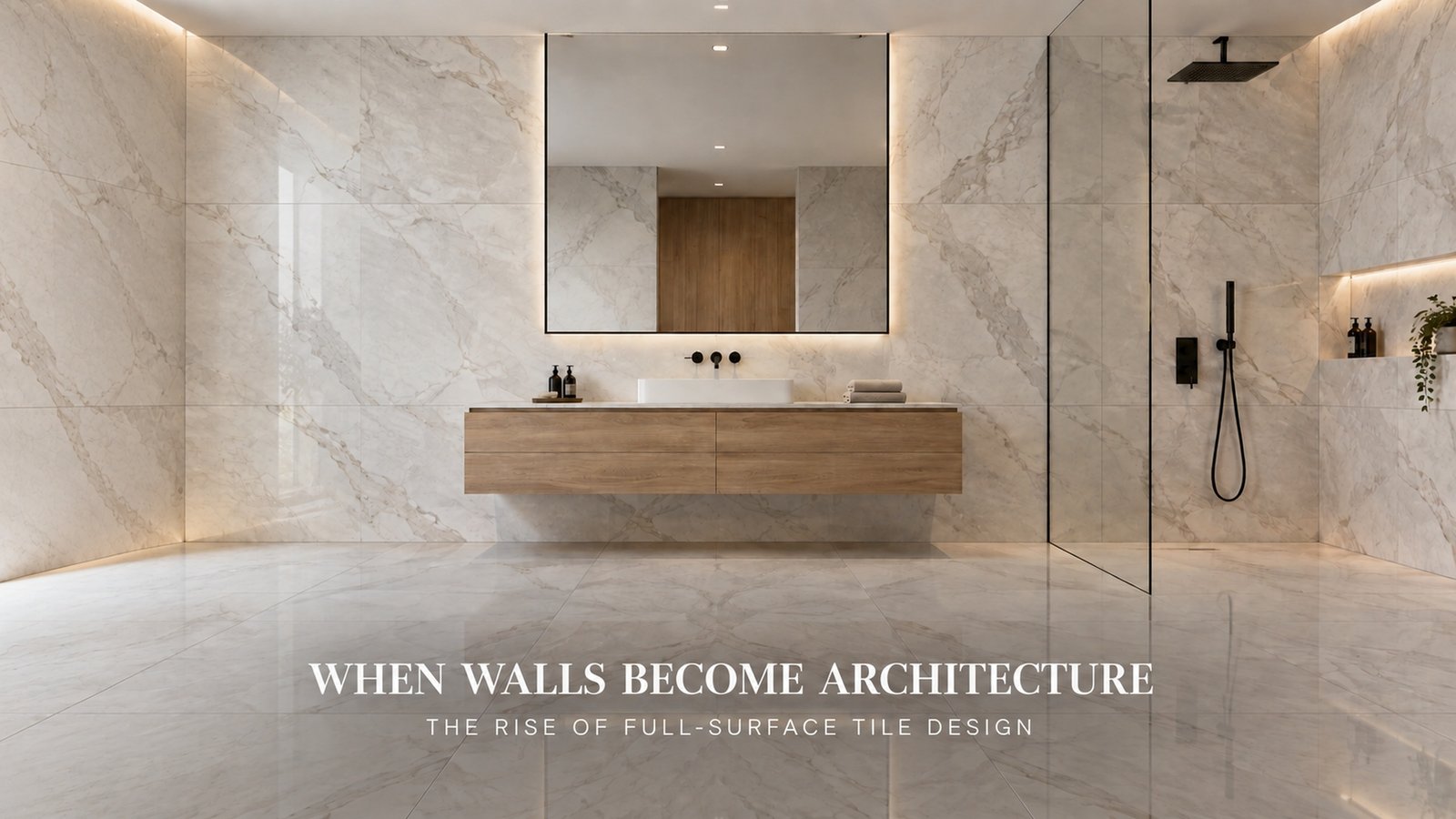
For decades, walls were treated as the quietest part of a room.
Paint them. Hang something on them. Add a little decoration.
Then move on to the furniture.
That approach is changing.
In contemporary interiors, walls are increasingly being treated as part of the architecture itself. Instead of simply providing a backdrop, the surface can define the mood, create depth, connect different areas, and sometimes become the most memorable element in the room.
This shift is particularly visible in the growing use of large-format porcelain and vitrified tiles across walls, from living rooms and kitchens to bathrooms, hospitality spaces, entrances, and commercial interiors.
The idea is simple:
The Wall Is No Longer Just a Background
Walk into a traditional interior and you may notice the furniture first.
Walk into a carefully designed contemporary space and your eye might be drawn to the material surrounding everything else.
A dramatic marble-inspired wall behind a fireplace.
A continuous stone-look surface running through a bathroom.
A textured feature wall catching afternoon light.
A large-format porcelain backdrop extending behind a kitchen counter.
These aren't simply decorative decisions.
They change how the architecture is perceived.
The wall begins to establish the visual identity of the space before furniture, artwork, or accessories are even introduced.
There is something visually powerful about continuity.
When a surface covers a large area without excessive interruptions, the eye reads it as one architectural element.
Large-format tiles can help create this effect by reducing the number of visible grout lines.
Instead of seeing dozens of individual pieces, you experience a broader field of material.
This can make a room feel more composed and intentional.
It can also allow the natural movement within stone-inspired patterns or marble-look surfaces to become part of the architecture rather than simply a decorative pattern repeated across individual tiles.
The result can be dramatic without requiring the room to be filled with decoration.
Feature walls aren't new.
What is changing is how they're being approached.
The traditional feature wall often relied on a contrasting paint color or patterned wallpaper.
Today's version can be much more architectural.
A wall can use:
Subtle tonal variations
The difference is that the material itself creates the statement.
There is no need to add something on top of it.
The surface becomes the feature.
One of the biggest developments in modern tile design is the availability of larger formats.
Larger tiles can create a sense of scale that smaller formats often cannot.
This becomes particularly effective in contemporary homes with high ceilings, open-plan layouts, expansive bathrooms, and large living areas.
A large-format surface can visually stretch across a wall, making the material feel closer to a continuous architectural panel than a conventional tile installation.
That is particularly powerful when the design contains subtle veining or natural movement.
Instead of interrupting the pattern every few inches, the larger format allows the visual story to breathe.
Marble has traditionally been associated with floors, countertops, and luxury bathrooms.
Today, marble-inspired surfaces are being used much more expansively.
A dramatic marble-look porcelain wall can frame a fireplace.
A softer stone-inspired surface can extend from the floor onto the wall.
A richly veined surface can create a sophisticated kitchen backdrop.
A bathroom can use the same visual language across walls and floors to create a more immersive environment.
The effect is less about “using marble” and more about using the visual language of natural stone as architecture.
Modern vitrified and porcelain surfaces make this approach particularly versatile, allowing designers to explore the look across different applications.
Few rooms demonstrate this shift better than the bathroom.
For years, bathrooms were largely designed around fixtures.
Sink.
Shower.
Bathtub.
Toilet.
Today, the surrounding surfaces are becoming equally important.
A bathroom can now be designed almost like a private retreat, with walls, floors, niches, shower areas, and vanity zones working together as one material composition.
Instead of introducing several competing patterns, designers can use one sophisticated surface across larger areas and allow lighting and fixtures to provide the contrast.
This creates a calmer, more immersive environment.
And it is one reason large-format tile has become so relevant to contemporary bathroom design.
The kitchen has undergone an even bigger transformation.
It is no longer hidden away as a purely functional room.
In many American homes, the kitchen is now part of the social heart of the house.
That makes its walls increasingly visible.
A backsplash is no longer simply something installed behind the cooktop to protect the wall.
It can become a major visual element.
A full-height backsplash can extend from the countertop to the upper cabinetry or beyond.
A large-format stone-look surface can create the appearance of a continuous slab.
A textured tile can add depth to an otherwise minimal kitchen.
The result is a kitchen that feels designed rather than simply equipped.
Not every space needs a major architectural renovation.
Sometimes the perception of architecture can be changed through the surface itself.
Texture is especially effective here.
A lightly raised pattern can catch sunlight.
A carved finish can create shadow.
A structured surface can visually divide zones.
A wood-inspired wall can introduce warmth into a contemporary space.
A stone-inspired finish can make a simple wall feel more substantial.
The architecture hasn't necessarily changed.
But the way the architecture is experienced has.
That is the power of surface design.
One of the biggest advantages of using tile as an architectural element is that it can reduce the need for additional decoration.
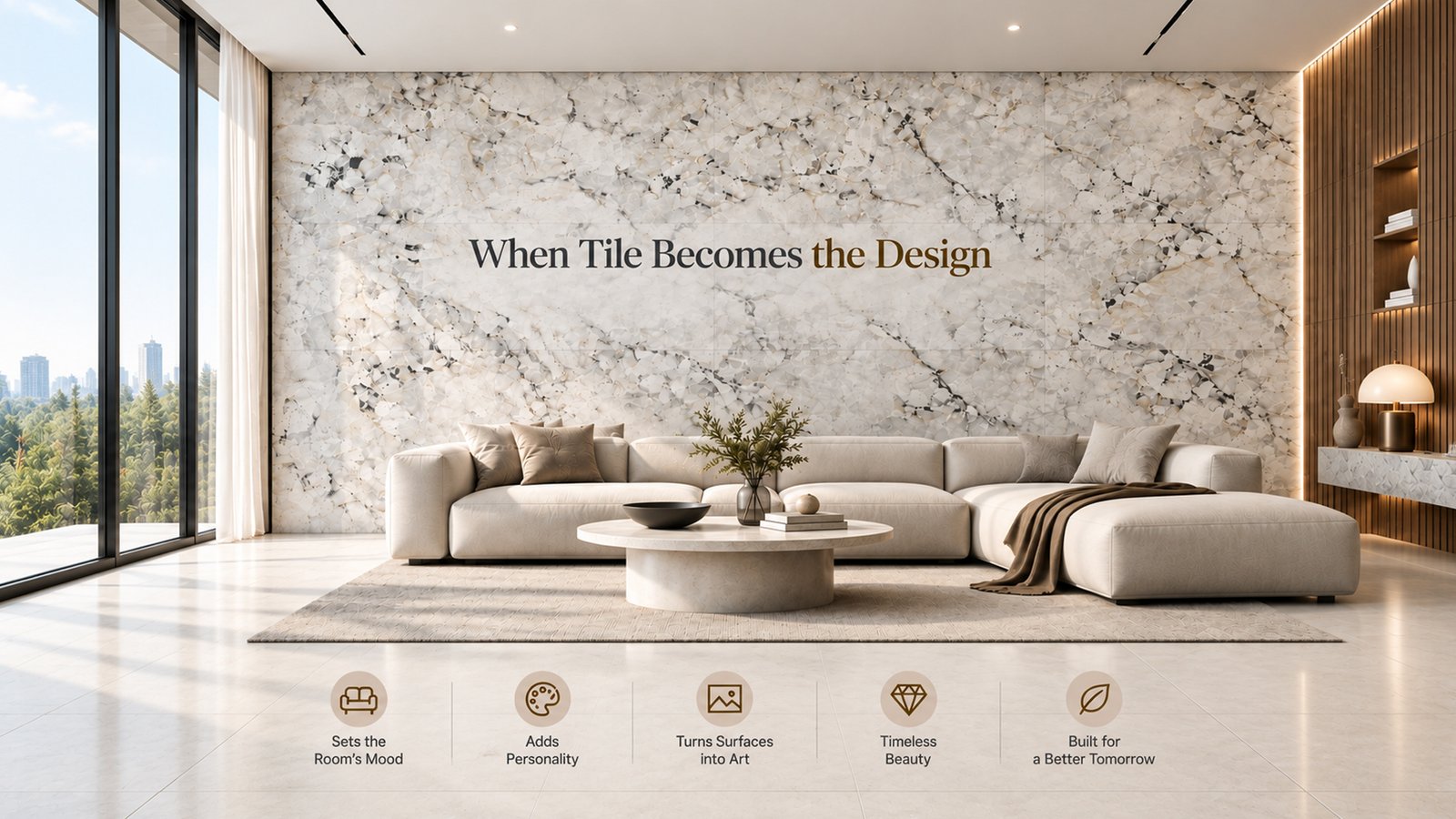
Imagine a living room with a beautifully detailed stone-inspired wall.
It may not need a large collection of artwork.
A sophisticated bathroom with continuous marble-look surfaces may not need multiple decorative materials.
A kitchen with an expressive full-height backsplash may not require an elaborate collection of accessories.
The surface already has enough visual information.
This is particularly relevant to modern minimalist interiors, where designers often want richness without visual clutter.
The room can remain restrained while still feeling luxurious.
Surface design becomes even more interesting when natural and artificial light enter the picture.
A flat wall can look completely different when the material has texture, variation, or reflective qualities.
Morning sunlight can reveal subtle movement.
Side lighting can emphasize relief and texture.
Warm evening lighting can soften a stone-inspired surface.
This means wall tile selection shouldn't happen independently of lighting design.
The two work together.
A surface with character gives light something to interact with.
And light gives the surface another dimension.
Full-surface design isn't only about making one wall impressive.
It can also help connect different areas.
A similar stone-inspired material might appear in an entryway, continue through a living space, and reappear in a bathroom.
The surfaces don't have to be identical.
They simply need to share a visual relationship.
This creates continuity across the home without making every room look the same.
For open-plan American homes, where kitchens, dining areas, and living rooms often flow into one another, this can be particularly effective.
The surface becomes a quiet thread connecting the architecture.
There is an important balance here.
If every wall is dramatic, no wall is dramatic.
The most successful interiors know where to create emphasis.
One large-format feature wall can be enough.
A subtle textured surface may be better for another area.
A quiet neutral floor can allow a more expressive wall to dominate.
A restrained bathroom can benefit from one richly veined surface rather than five competing patterns.
Good surface design is therefore not about maximizing decoration.
It is about creating hierarchy.
American residential architecture is particularly well suited to this approach.
Open-plan living spaces, large kitchens, generous bathrooms, fireplaces, expansive entryways, and indoor-outdoor connections create opportunities for surfaces to play a larger architectural role.
Homeowners are also increasingly investing in renovations intended to last.
That makes permanent finishes more important.
Furniture trends can change quickly.
A well-designed wall surface can remain relevant for many years.
Choosing one thoughtfully can therefore have a greater impact than constantly updating decorative accessories.
The best architectural materials aren't necessarily the ones that attract attention immediately.
They are the ones that continue to look appropriate as the rest of the room evolves.
Furniture changes.
Art changes.
Lighting changes.
Personal tastes change.
A sophisticated stone-inspired or neutral surface can provide a stable foundation through those changes.
This is one reason timeless material references remain so powerful.
Natural stone, wood, concrete, and mineral-inspired aesthetics have existed for generations.
Modern tile technology simply gives designers new ways to interpret them.
The future of interior walls may have less to do with what we hang on them and more to do with what they are made of.
As large-format tile technology, surface printing, texture, and finish development continue to evolve, designers have more ways to create walls that feel dimensional, sophisticated, and architectural.
This doesn't mean paint, wallpaper, or artwork are disappearing.
Far from it.
It means homeowners now have another powerful design tool.
The wall itself.
At Flavour Granito, tile is not limited to the role of conventional flooring or wall covering.
Premium vitrified and porcelain surfaces can become part of the broader architectural composition.
Natural stone-inspired designs can introduce depth and movement.
Large formats can create visual continuity.
Matte and polished finishes can produce different relationships with light.
Textured and carving surfaces can introduce dimension.
Wood-inspired designs can bring warmth to contemporary architecture.
The possibilities depend on how the surface is used.
And that is ultimately what makes modern tile design so exciting.
The material is no longer simply something that finishes the architecture.
It can help create the architecture's visual identity.
Interior design is often thought of as the art of choosing what goes inside a room.
But increasingly, it is also about understanding the surfaces that define the room itself.
Walls can create atmosphere.
Floors can establish scale.
Textures can manipulate light.
Large formats can create continuity.
Natural-inspired patterns can introduce movement.
And a thoughtfully selected tile can become an architectural feature rather than simply a practical necessity.
The next time you look at an empty wall, don't immediately ask what you should put on it.
Ask a different question:
Because in modern interiors, the most powerful decoration may not be something added to the architecture.
may be the architecture itself.
What started 25 years ago in Morbi, India’s ceramic hub, has grown into a trusted global brand. At Flavour Granito, we’ve built our legacy on creating tiles that blend artistry.
Quick Links
Available Sizes
Flavour Granito © . All rights reserved | Design and Managing By Roex Design