
Choosing tile can seem simple.
You find a color you love, choose a pattern that works with the room, check the size, and place the order.
But a tile that looks perfect in a showroom or even on a screen, does not automatically mean it will be the right choice for your home.
The difference often comes down to details that are easy to overlook: how the room receives light, how much traffic the surface will experience, whether the tile format suits the proportions of the space, how the finish will look after installation, and whether the design will still feel right years later.
With so many porcelain, vitrified, ceramic, large-format, wood-look, stone-look, textured, matte, and polished options available today, homeowners have more choices than ever.
That makes knowing what not to do just as important as knowing what to choose.
Here are some of the most common tile mistakes, and how to avoid them.
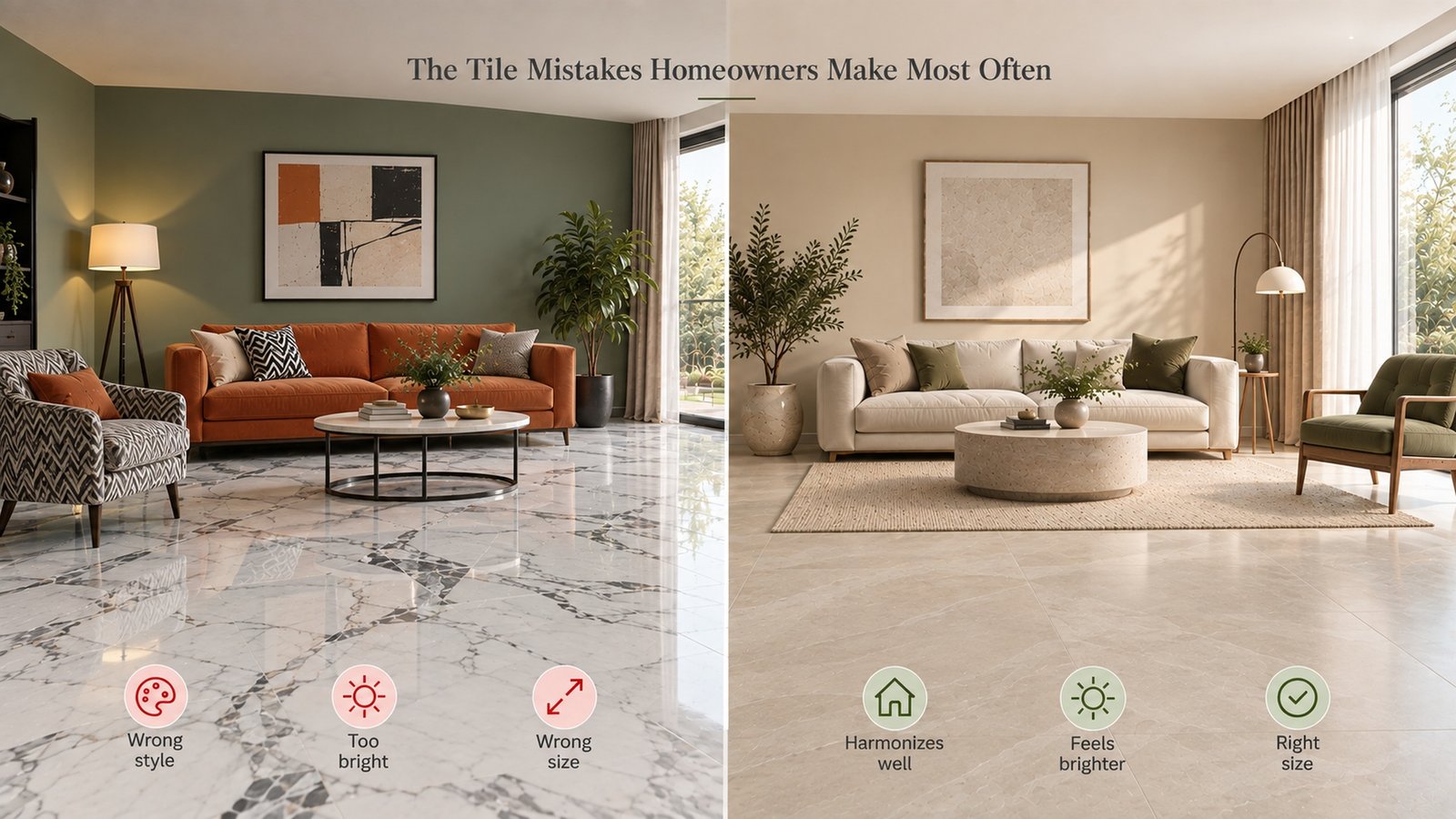
One of the easiest mistakes is falling in love with a tile before considering everything around it.
A tile may look beautiful on its own but feel completely different once it is placed beside cabinetry, countertops, furniture, paint colors, lighting, and architectural details.
For example, a heavily veined marble-look tile may become overwhelming in a room that already has bold cabinetry and statement lighting. On the other hand, a very plain tile may disappear in a space that needs more visual character.
The solution is to think about the entire material palette.
Before choosing a tile, consider:
The goal is not for every element to match.
It is for the elements to make sense together.
A tile can look dramatically different under different lighting conditions.
A warm beige may appear creamy in one room and noticeably darker in another. A polished surface can reflect sunlight beautifully, while a darker matte tile may absorb more light and create a moodier atmosphere.
This is particularly important when choosing large surfaces because they occupy a significant portion of the visual field.
Before making a final decision, look at the tile sample at different times of day.
Morning light.
Afternoon light.
Evening lighting.
The surface should still look appealing when the lighting changes.
This small step can prevent a surprisingly expensive design mistake.
Tile size can completely change how a room feels.
Large-format tiles can create visual continuity and reduce the number of grout lines, making them especially effective in open-plan spaces and contemporary interiors.
Smaller formats, meanwhile, can introduce rhythm, detail, or a more decorative character.
Neither is automatically better.
The mistake is choosing a size simply because it is currently popular.
Consider the dimensions and proportions of the room first.
A large format can make a spacious room feel more continuous, while a smaller format may be better suited to areas where scale and detailing are important.
The right question is not:
“What tile size is trending?”
It is:
“What tile size makes this space work better?”
Finish is not just a visual decision.
It affects how a surface interacts with light, how it feels, and how practical it is for its intended application.
Polished surfaces can create a bright, sophisticated appearance and emphasize the movement within stone-inspired designs.
Matt surfaces tend to create a softer, more understated look.
Textured and carving finishes can introduce depth and visual interest.
Wood-inspired surfaces can bring warmth without requiring actual wood flooring.
The mistake is selecting a finish solely because it looks attractive in a photograph.
Think about where the tile will be installed and what experience you want the surface to create.
A living room, bathroom wall, kitchen backsplash, bedroom floor, and commercial entrance may all call for different surface considerations.
Tile gets most of the attention.
Grout often gets treated as an afterthought.
But grout lines can significantly influence the final appearance of a tiled surface.
A contrasting grout can emphasize the geometry of individual tiles.
A closely matched grout can create a more continuous appearance.
With large-format tiles, the overall visual effect can be especially dependent on installation and joint consistency.
Grout color, joint width, installation quality, and layout should therefore be considered alongside the tile not after the tile has already been selected.
Sometimes the difference between a surface that looks ordinary and one that looks refined is not the tile itself.
It is how the tile was installed.
Interior trends can be useful sources of inspiration.
But there is a difference between being inspired by a trend and designing an entire home around one.
Tile is a relatively permanent design decision.
Furniture can be replaced.
Accessories can be changed.
Paint can be updated.
Replacing an entire tiled floor or wall is considerably more involved.
That is why timeless materials often provide a stronger foundation.
Stone-inspired porcelain, warm neutrals, understated textures, refined wood looks, and carefully selected large-format surfaces can work across changing interior styles.
The objective is not to avoid trends completely.
It is to choose trends that can evolve with you.
Large-format tile has become increasingly popular, particularly in contemporary residential design.
But larger does not automatically mean more luxurious.
The success of a large-format tile depends on the room, installation conditions, layout, pattern, and overall design.
A large surface can create beautiful continuity when used thoughtfully.
But if the format overwhelms the architecture or requires awkward cuts, the result may be less successful.
Tile size should follow the architecture, not the other way around.
A beautiful surface still needs to work with real life.
A homeowner should consider how the room is used before making a final tile decision.
Is it a busy kitchen?
A high-traffic entry?
A family bathroom?
A quiet bedroom?
A commercial environment?
Different spaces place different demands on surfaces.
This is one reason porcelain and vitrified tiles are popular choices for modern interiors: they can combine a wide range of design possibilities with the durability expected from everyday surfaces.
But even with durable materials, homeowners should understand the manufacturer's recommendations for cleaning, installation, and ongoing care.
The best tile is one that looks beautiful and fits the way you live.
A small sample tells you something.
A full tiled surface tells you much more.
Patterns can appear stronger when repeated across a large area. Subtle variations may become more noticeable. Veining can move differently from one tile to another. Texture can interact with light in ways that are difficult to understand from a single piece.
Whenever possible, homeowners should visualize how multiple tiles will work together.
This is particularly important for natural stone-inspired designs, wood-look surfaces, large formats, and tiles with pronounced patterns.
You are not really buying one tile.
You are buying the visual rhythm created by many tiles together.
Digital visualization has made tile shopping much easier.
But screens are not always able to communicate the complete experience of a material.
Color can vary between displays. Texture can be difficult to understand digitally. The scale of a pattern can appear different on a screen than it does across an actual wall or floor.
Online research is an excellent starting point.
However, samples, professional guidance, and real-world visualization can help make the final decision more reliable.
The closer you can get to experiencing the material in the environment where it will be installed, the better.
Another common mistake is choosing each surface independently.
The floor is selected first.
Then the backsplash.
Then the bathroom walls.
Then perhaps another tile for a feature wall.
The result can sometimes feel visually disconnected.
Instead, think about the home as a sequence of spaces.
The tiles do not need to be identical throughout the house. But they should have some relationship in terms of color, texture, material inspiration, or overall mood.
A consistent design language can make a home feel more considered without making every room look the same.
Great tile selection should not force homeowners to choose between beauty and practicality.
Modern porcelain and vitrified tile manufacturing has expanded the range of surfaces available to designers and homeowners, allowing materials to replicate the visual qualities of stone, wood, concrete, and other design references while serving practical everyday applications.
That gives homeowners more freedom.
You can create warmth without necessarily using natural wood.
You can introduce stone-inspired elegance without relying exclusively on natural stone.
You can create visual texture without filling a room with decorative objects.
The strongest tile choices bring these considerations together.
A Better Way to Choose Tile
Instead of starting with a color or pattern, start with the space.
Ask:
How is this room used?
Then consider:
What atmosphere should it create?
Next:
How much light does it receive?
Then:
What other materials will surround the tile?
And finally:
Will I still like this surface years from now?
Once those questions are answered, choosing the right tile becomes much easier.
It becomes less about selecting something that looks good in isolation and more about finding a surface that belongs in the space.
The Right Tile Is More Than a Beautiful Surface
Tile has the power to completely change how a room feels.
But great tile selection is rarely about finding the most expensive, dramatic, or fashionable option.
It is about finding the right relationship between design, scale, material, performance, light, and lifestyle.
That is what turns a tile from a product into part of the architecture.
At Flavour Granito, a broad selection of ceramic, porcelain, GVT, PGVT, vitrified, and expressive surface options allows homeowners, designers, and architects to explore different visual directions while considering the practical needs of modern spaces.
Because the best tile decision is not necessarily the one that makes you say “That tile is beautiful.”
It is the one that makes you look at the finished room and think:
“Everything feels right.”
31-08-2026
What started 25 years ago in Morbi, India’s ceramic hub, has grown into a trusted global brand. At Flavour Granito, we’ve built our legacy on creating tiles that blend artistry.
Quick Links
Available Sizes
Flavour Granito © . All rights reserved | Design and Managing By Roex Design