Few things are more frustrating after a tile installation than hearing a sudden crack, pop, or hollow sound underfoot and discovering that a tile has lifted from the floor.
Sometimes a single tile rises at the edge.
Sometimes several tiles appear to push against one another.
In more serious cases, an entire section of flooring can buckle upward, creating what homeowners often describe as “popped” or “tenting” tiles.
It can be surprising, and expensive if the underlying problem is not addressed.
But why does it happen?
The answer is rarely as simple as “the tile came loose.” Tile flooring is a system made up of the tile, adhesive or mortar, substrate, grout joints, movement joints, and surrounding structure. When one part of that system cannot accommodate movement or has been installed incorrectly, stresses can build until the tile has nowhere to go but up.
Understanding the common causes can help homeowners, contractors, and designers prevent the problem before it starts.
Tile popping occurs when one or more tiles lose their intended position and lift, crack, or separate from the substrate.
In some situations, the tiles remain relatively intact but rise because pressure has developed within the tiled surface. In others, poor bonding causes tiles to become loose or detach.
A common and particularly noticeable form is tile tenting.
Imagine a row of tiles that has nowhere to expand. As the tiled surface experiences movement or temperature-related changes, pressure builds between the tiles. Eventually, that pressure can cause one section to lift away from the substrate.
It can look sudden, but the stresses behind it may have been developing for a long time.
One of the most important causes of tile tenting is insufficient provision for movement.
Buildings move.
Substrates can expand and contract.
Temperature changes can affect materials.
Large tiled areas can therefore experience stresses that need somewhere to dissipate.
Movement joints are designed to accommodate this type of movement instead of forcing the stress into the tile installation.
When movement joints are missing, incorrectly positioned, or inadequately designed, the pressure can accumulate within the tiled surface.
Eventually, something gives.
For large residential floors, expansive open-plan areas, commercial spaces, and installations exposed to significant temperature changes, movement planning becomes particularly important.
Tile adhesive does more than simply hold a tile in place.
It needs to create an appropriate bond between the tile and substrate while providing adequate coverage for the installation.
If adhesive is applied incorrectly, coverage can be insufficient.
This can happen when:
Large-format tiles require particularly careful installation because their size makes proper adhesive coverage and substrate preparation even more important.
A beautiful tile cannot compensate for an installation system that has not been properly prepared.
Tiles follow the surface beneath them.
If the substrate is uneven, contaminated, weak, dusty, damp beyond acceptable limits, or otherwise unsuitable, the finished installation can suffer.
Before tile installation begins, the substrate should be evaluated and prepared according to the applicable installation requirements.
Cracks, uneven areas, loose material, construction debris, and other issues should not simply be covered with tile and forgotten.
A strong installation starts underneath the tile.
This is especially important for large-format porcelain and vitrified tiles because the larger surface area can make substrate flatness and installation precision more demanding.
Temperature can affect building materials.
Interior spaces may experience changes caused by sunlight, heating, cooling, underfloor heating systems, exterior exposure, or large temperature fluctuations.
When a tiled surface is installed without appropriately accommodating expected movement, stresses can accumulate.
This is one reason professional tile installation should consider the environment in which the tile will be used not simply the appearance of the finished surface.
A tile installation near large windows with strong solar exposure may experience different conditions from one installed in an interior hallway.
The material selection and installation system need to account for the application.
A tiled floor needs room to accommodate movement.
One common mistake is treating the perimeter of a tiled area as though it were simply another grout joint.
Where movement accommodation is required, the perimeter and other relevant transitions need to be detailed appropriately rather than creating a completely rigid installation.
The same principle applies around structural elements, changes in plane, and other areas where movement may occur.
These details may be easy to overlook because they are often hidden beneath baseboards, cabinets, or trim.
But small installation details can have a major impact on long-term performance.
Even high-quality tile can perform poorly when installation practices are inconsistent.
Common problems can include inadequate adhesive coverage, incorrect adhesive consistency, poor substrate preparation, unsuitable grout or installation materials, and insufficient attention to movement requirements.
Installation is therefore not the place to cut corners.
Tile is a finished architectural surface, but its performance depends heavily on what happens before and during installation.
A professional installer should follow the tile manufacturer's recommendations as well as relevant industry installation standards and project-specific requirements.
Moisture can create problems when a tile assembly has not been designed for the conditions of the space.
Bathrooms, wet areas, exterior applications, and spaces with moisture-sensitive substrates require appropriate installation systems.
The solution is not simply to use a waterproof-looking tile.
The entire assembly including the substrate, waterproofing where required, adhesives, joints, and drainage needs to be appropriate for the application.
This is particularly important because a tile itself can remain visually intact while problems develop underneath it.
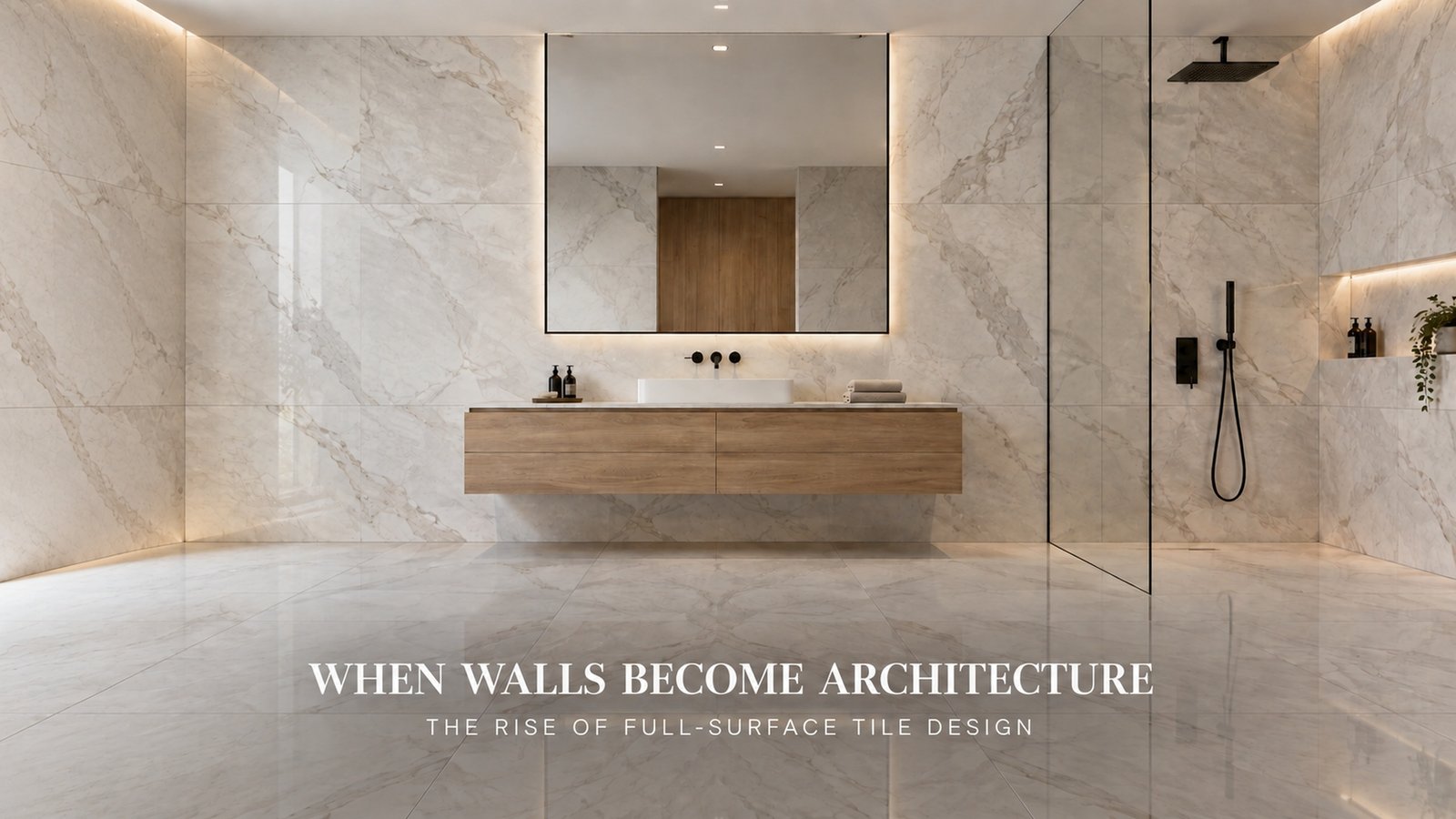
Large-format tile has become increasingly popular because it creates clean visual lines and reduces the number of grout joints.
But larger tiles can also make installation requirements more demanding.
The substrate needs to be suitably flat.
Handling and positioning require greater precision.
Adhesive coverage becomes particularly important.
Layout planning matters.
Movement accommodation needs to be considered carefully.
This does not mean large-format porcelain or vitrified tiles are difficult to use.
It means they should be installed as an architectural system rather than treated exactly like a small-format tile.
Renovation projects often involve installing new tile over an existing floor.
While tile-over-tile or other overlay systems can sometimes be appropriate, the existing surface must first be evaluated.
Is the existing tile securely bonded?
Is the substrate stable?
Is the surface clean and suitable for the new installation system?
Will the additional height create problems at doors, transitions, appliances, or adjoining rooms?
Simply placing new tile over an unstable surface does not eliminate the original problem.
It can carry that problem into the new installation.
Not every tile, adhesive, grout, or installation product is appropriate for every environment.
Flooring, walls, wet areas, exterior spaces, high-traffic commercial areas, and specialty applications can have different requirements.
Tile selection should therefore consider more than appearance.
Before installation, confirm:
A good tile installation is a coordinated system.
The good news is that many problems associated with tile movement can be reduced through proper planning and installation.
Do not treat the existing floor as something that simply needs to be covered.
Have it evaluated before installation.
Any cracks, weak areas, unevenness, contamination, or moisture concerns should be addressed appropriately.
The adhesive, grout, substrate preparation, movement joints, and installation technique should all be compatible with the tile and application.
For large-format porcelain and vitrified tiles, follow the manufacturer's specific installation guidance.
Movement accommodation should be considered during planning, not after the floor has already been installed.
This includes appropriate joints and transitions based on the size and conditions of the installation.
A tile may be one of the most visible elements of an interior, but much of its long-term performance depends on work that becomes invisible once the project is complete.
Experienced tile installers understand how substrate preparation, adhesive coverage, layout, joints, and material selection work together.
That expertise can prevent problems that are expensive to correct later.
This is not directly related to tile popping, but it is an important part of a successful tile project.
Ordering enough material for the complete installation and keeping additional tiles for future repairs can make long-term maintenance much easier.
It is particularly useful for tiles with natural-looking variation, where replacement pieces from a different production run may not have exactly the same appearance.
If you notice a tile lifting, cracking, or suddenly sounding hollow, don't simply press it back down or replace the visible tile without investigating the cause.
The first step should be understanding why it happened.
An installer or qualified professional can inspect the affected area and determine whether the issue involves:
Replacing one tile may solve the appearance of the problem without solving the reason it happened.
If the underlying cause remains, other tiles may eventually experience the same issue.
Choosing a beautiful tile is only one part of creating a successful floor or wall.
The tile itself, substrate, adhesive, grout, movement joints, environmental conditions, and installation technique all contribute to the final result.
That is particularly important as modern interiors increasingly use larger formats and expansive tiled surfaces.
The bigger the visual canvas, the more important the installation details become.
At Flavour Granito, our range of porcelain, vitrified, GVT, PGVT, and ceramic tiles is designed to support a wide variety of residential and commercial applications. But selecting the right surface is only the beginning. Proper substrate preparation, compatible installation materials, movement planning, and professional installation are essential to achieving the performance and appearance expected from a finished tile installation.
Because a great tile should not only look beautiful on the day it is installed.
It should continue to perform beautifully for years to come.
Tiles rarely pop for just one simple reason.
Most problems develop because something within the installation system could not accommodate movement, did not bond correctly, or was not prepared properly.
The best prevention strategy is therefore not complicated:
Choose the right tile. Prepare the right foundation. Use the right installation system. Allow for movement. And install it correctly.
When those elements work together, tile can provide what it is meant to provide a durable, beautiful surface that becomes part of the architecture rather than a problem waiting to happen.



What started 25 years ago in Morbi, India’s ceramic hub, has grown into a trusted global brand. At Flavour Granito, we’ve built our legacy on creating tiles that blend artistry.
Quick Links
Available Sizes
Flavour Granito © . All rights reserved | Design and Managing By Roex Design